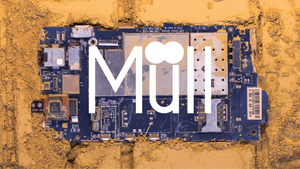
Müll. Eine Ausstellung über die globalen Wege des Abfalls

In the organizer's words:
What happens to the waste of a globalized consumer society - and who bears the consequences? The special exhibition "Waste. An exhibition about the global routes of waste" is dedicated to the worldwide routes of waste and their social, ecological and political effects. Around 50 international works of art from the 20th and 21st centuries are on display, including two specially commissioned works developed for the exhibition.
Art and waste since the 1960s
Based on the Museum Ostwall collection, which took up artistic explorations of waste and consumption in global and regional contexts at an early stage, the exhibition brings historical positions since the 1960s into a dialog with contemporary art. Artists examine waste as a material remnant of prosperity, as a repressed by-product of modern lifestyles and as an expression of global inequalities.
Early examples include HA Schult's action Situation Schackstraße (1969), in which several tons of waste were dumped on a Munich street to radically disrupt the supposedly "clean" cityscape. Nancy Holt's drawings for Sky Mound (1985) show a visionary design for the transformation of a landfill in New Jersey into a park-like land art sculpture. Anna Zett's video work Freiheit 3 (2019) addresses the toxic history of the Bitterfeld landfill and the ambivalent promises of freedom after 1989.
Global waste routes and colonial continuities
One focus of the exhibition is on colonial continuities in global waste flows. Artistic works make visible how waste from the global North is often exported to countries in the global South, where it causes ecological damage and creates new dependencies. Karimah Ashadu's video work Brown Goods (2020) follows an informal cycle of used electrical appliances between Europe and Africa. Ana Alenso 's current commissioned work Obsolete Swing sheds light on the toxic processes involved in extracting raw materials from electronic waste. With TC-2000, Akwasi Bediako Afrane designs an Afro-futuristic science fiction city built from electronic waste.
Power relations, bodies and spaces
A central installation in the exhibition is Los de arriba y los de abajo (2015) by Kader Attia. A narrow walkway with garbage and scrap metal above the heads of the visitors creates physical discomfort; only wire mesh protects them from falling garbage. The work refers specifically to the situation in Hebron, where the Palestinian population uses nets to protect themselves from the garbage from the higher-lying Israeli settlements, and at the same time refers generally to the separation of "above" and "below" in hierarchical societies. The waste becomes not only a symbol, but a real, permanently present component of an everyday life characterized by power and inequality.
The exhibition brings together works from installation, sculpture, photography, video, graphics and media art by artists including Akwasi Bediako Afrane, Ana Alenso, Arman, César Baldaccini, Karimah Ashadu, Nancy Holt, Allan Kaprow, Krištof Kintera, HA Schult, Tejal Shah and Klaus Staeck.
The Olchis support the education program
An extensive educational program with guided tours, workshops, lectures and work stations invites visitors to take a closer look. Erhard Dietl's Olchis accompany children and young people through the exhibition; a specially developed hands-on booklet complements the program.
Further information on the supporting program and bookable offers is available online: www.dortmunder-u.de/muell
This content has been machine translated.Price information:
9 Euro / 5 Euro reduced
Location
You might enjoy this as well?



Events near you
Activities near you
Popular event locations
The best event recommendations for the Rausgegangen App!

Gemeinsam Events erleben
Events werden noch schöner wenn wir sie teilen! Deshalb kannst du dich jetzt mit Friends und anderen Usern vernetzen um Events gemeinsam zu besuchen. Loslegen