NDR Elbphilharmonie Orchester mit Johan Dalene & Jukka-Pekka Saraste in Lübeck
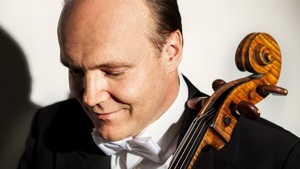
In the organizer's words:
"Bards" from the north: The Finn Jukka-Pekka Saraste returns to the podium of the NDR Elbphilharmonie Orchestra with Tchaikovsky's "Pathétique", while the Swedish violinist Johan Dalene makes his debut.
Introductory event at 6.30 pm
Jukka-Pekka Saraste Conductor
Johan Dalene violin
NDR Elbphilharmonie Orchestra
JEAN SIBELIUS
The Bard op. 64
THOMAS ADÈS
Violin concerto "Concentric paths" op. 23
PETER TCHAIKOVSKY
Symphony No. 6 in B minor op. 74 "Pathétique"
Sibelius: a timeless portrait of an artist
Jean Sibelius called one of his many symphonic poems "The Bard". What's happening in the piece exactly is not revealed. Only that the focus is on a wandering poet and singer, just as he appears in many legends of Nordic mythology. And this bard is of course given "his" instrument: the harp, which plays an important role in Sibelius' score. Sibelius was probably simply interested in creating a timeless portrait of an artist - after all, aren't he himself and his performers basically all "bards"?
Diving deep: Saraste with Tchaikovsky's "Pathétique"
One of them is his compatriot, the Finn Jukka-Pekka Saraste, who as a conductor is one of the most sensitive "Sibelius bards" on the scene. He has proven this impressively with the NDR Elbphilharmonie Orchestra in performances of his symphonies. You can't do without Sibelius completely, but this time the current head of the Helsinki Philharmonic Orchestra leaves it at the eight-minute opening piece and devotes himself to an absolute heavyweight of Russian Romanticism: Peter Tchaikovsky's highly emotional "Pathétique". In his last and probably most popular symphony, the composer unrolls a powerful musical panorama of human sorrows, joys, sufferings and hopes before our ears with passionate sounds. Until the possibly autobiographical work sinks sadly into the depths at the end...
Around the middle: "Concentric paths" by Adès
Tchaikovsky's Sixth thus has an emphatic "ending" - a category that Thomas Adès actually wants to avoid in his violin concerto "Concentric paths". In keeping with the title, the successful British composer was concerned with the idea of aimless "concentric" circles around a center point - without beginning or end. Of course, this cannot be fully realized in the linear art form of music, but at least in this case the expressive middle movement is the longest and most important of the concerto. With over 1,000 performances worldwide, it has long since become a contemporary classic and fascinates the greatest violinists of our time - including the Swedish-Norwegian high-flyer Johan Dalene, who is said to have an incredibly "singing" tone. A true "bard"...
This content has been machine translated.Price information:
Discounts available (e.g. U30)
Location
Location | Venue
Organizer | Event Series

You might enjoy this as well?






Events near you
Activities near you
Popular event locations
The best event recommendations for the Rausgegangen App!

Gemeinsam Events erleben
Events werden noch schöner wenn wir sie teilen! Deshalb kannst du dich jetzt mit Friends und anderen Usern vernetzen um Events gemeinsam zu besuchen. Loslegen