
In the organizer's words:
BERNARDA ALBA'S HOUSE
by Federico García Lorca
Content
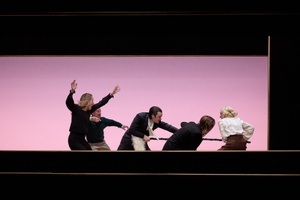
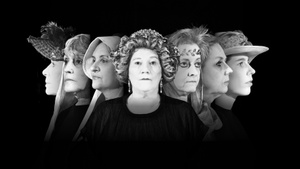
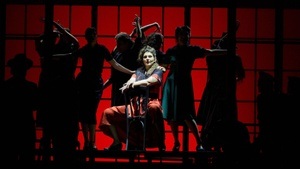
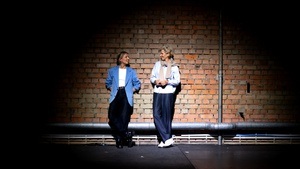
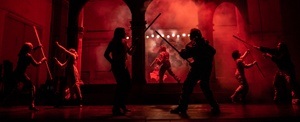
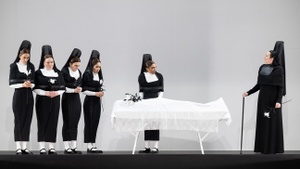
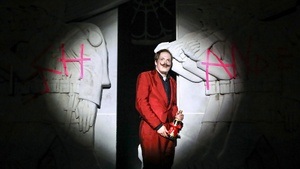
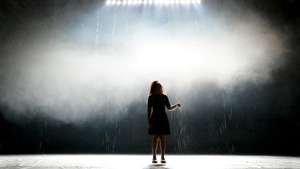
After the death of her husband, Bernarda Alba declares eight years of mourning and locks her five daughters at home. All contact with the outside world is forbidden. She rules by means of surveillance, denunciation and violence. But the youngest daughter dares to rebel against her mother's regime, who unquestioningly adopts the patriarchal system of the Spanish province.
The Spanish poet Federico García Lorca repeatedly focused on the fate of women. Shortly before his murder by insurgent fascist soldiers in 1936, he completed "Bernarda Alba's House", perhaps his most consistent play. It can be read as an indictment of the traditional misogynistic moral concepts propagated by the Catholic Church and as a call for radical social change. But a far more complex interpretation is possible, as Lorca ruthlessly exposes the sophisticated mechanisms of oppression between women, which are directed against themselves and their freedom. Lorca found the model for "Bernarda Alba's House" in real life, as a house in which the women of a family were virtually imprisoned stood in the immediate vicinity of his parents' house.
Director Rieke Süßkow has already been invited twice to the Berlin Theatertreffen with her aesthetically composed works and is now staging her first production at the Residenztheater.
Artistic Director
Production Rieke Süßkow
Stage Marlene Lockemann
Costumes Sabrina Bosshard
Music Kostia Rapoport
Lighting Markus Schadel
Dramaturgy Almut Wagner
This content has been machine translated.Price information:
Pupils, students, trainees and volunteers up to the age of 30 receive discounted tickets for 10 euros.
Location





Events near you
Activities near you
Popular event locations
The best event recommendations for the Rausgegangen App!

Gemeinsam Events erleben
Events werden noch schöner wenn wir sie teilen! Deshalb kannst du dich jetzt mit Friends und anderen Usern vernetzen um Events gemeinsam zu besuchen. Loslegen