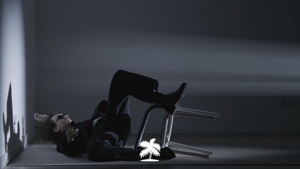
In the organizer's words:
Workshop talk with Hara Kazuo - in Japanese with English translation
The four films that Hara Kazuo made together with his producer and partner Kobayashi Sachiko between 1972 and 1994 understand reality in documentary film as being recorded by the film and produced by it.
Not simply because the filmmaker is present, but because he is present and intervenes to set reality in motion, in action. Hara's "action documentaries" accomplish this with great directness, in "plain sight" - in them, filmmaking is depicted as the negotiation of a conflict that is unfolded in the image, between the filmmaker and the protagonists as well as the viewers and the screen, and carried back into the world.
After Hara had already lived and worked among people with disabilities for several years, he made 'Goodbye CP' in 1972 together with the Green Lawn Movement, a group of activists with cerebral palsy. In the spirit of the student protests of the time, Hara's first film is a radical provocation and refraction of an ableist view: Hara makes the distance between his protagonists and the world around them visible, reinforces it and provokes it. The fact that he himself repeatedly transgresses boundaries, reproduces violence or even creates it himself, tells us something about the conflictual complexity of wanting to escape the hierarchizing impositions of a society and oppose them. In Hara's films, there is never the (already nonsensical) self-assurance of doing everything right - rather, they depict the search for an attitude, including missteps and wrong decisions.
A little later, 'Extreme Private Eros: Love Song (1974)' was made, a film of which Hara writes in his book 'Camera Obtrusa': "So there was this love affair between a man and a woman; and then there was Okinawa, which had quite a bit of significance at the time. We thought of it as intense, as cutting-edge." This constellation between him and his former partner Takeda Miyuki develops into a film in which role models and desires, utopias and trivialities are played out passionately, encroachingly and captivatingly realistically along all of the film's visual axes. With 'The Emperor's Naked Army Marches On' (1987), completed 13 years later, Hara made a film that remains a quasi-legendary moment in militant cinema to this day. The portrait of the activist Okuzaki Kenzō in his search for the truth about some dead soldiers at the end of the Second World War escapes the usual formulas of the genre and escalates into a cinematic negotiation of violence as an artistic and political practice, into a battle of two staging desires in front of and behind the camera. Hara also encounters a self-dramatizer a few years later in 'A Dedicated Life' (1994): The writer Inoue Mitsuharu delights in the self-mythologization of his artist persona, which the film gradually reveals to be violent and a lie.
The dokumentarfilmwoche hamburg would like to place these films in dialog with a present in which questions about the relevance or resistance of political filmmaking are posed anew, or more strongly: Hara's "action documentaries" are not direct answers, but can contribute to unfolding the dimensions of the questions widely (occasionally to the much-praised pain threshold). During the festival, all four films will be screened and discussed in the presence of Hara. In addition, a longer workshop discussion will address larger contexts in detail and establish a connection to later works that deal with the same political stance in clearly different aesthetic forms. Following the festival, Hara's latest film, the six-hour 'Minamata Mandala' (2020), will be screened on Sunday, May 3 at B-Movie in Hamburg.
Organizer | Festival

You might enjoy this as well?













Events near you
Activities near you
Popular event locations
The best event recommendations for the Rausgegangen App!

Gemeinsam Events erleben
Events werden noch schöner wenn wir sie teilen! Deshalb kannst du dich jetzt mit Friends und anderen Usern vernetzen um Events gemeinsam zu besuchen. Loslegen