Haus Lemke – Die Möbel von Mies van der Rohe und Lilly Reich

In the organizer's words:
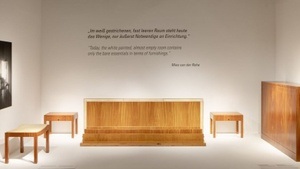
With the first complete presentation of the furniture from Haus Lemke in Berlin, the Kunstgewerbemuseum is showing one of the most extensive original interiors from the work of Ludwig Mies van der Rohe.
The furnishings of Haus Lemke are clearly based on the design developed by Mies van der Rohe and Lilly Reich from the mid-1920s onwards. Despite the spectacularly modern tubular steel furniture, veneered wooden furniture remained the basis of the interior design. In the style of the sophisticated interior design of their time, they combined the material aesthetics of fine wood, bound in strictly geometric shapes and room proportions, with no less elaborate processing of stone, glass and metal surfaces.
Lemke House: The "Mies van der Rohe House" in Berlin-Lichtenberg
Built in 1932/33, Haus Lemke is known today as the "Mies van der Rohe House". Situated on the Obersee in Alt-Hohenschönhausen (Lichtenberg district), the building, designed on a lakeside plot with a spacious garden, surprises with its restrained dimensions. The furnishing of Haus Lemke with furniture designed by Mies van der Rohe took place long after the building was handed over in April 1933. Mies submitted initial plans for the furnishing of the study at this time, but these were not implemented. The planning was presumably continued in 1934 with Lilly Reich and former employees such as Friedrich Hirz were also consulted. The study and bedroom were completely furnished according to the new designs, while existing furniture was used in the living room. According to Martha Lemke's recollection, the furnishings were not completed until 1937. It was presented in the same year in the Deutsche Bauzeitung with a photograph by Max Krajewsky, who had taken a series of interior photographs of the building at the time.
The end of the war and the expulsion of the owners in 1945 marked the beginning of the building's varied use as a car repair shop and warehouse, among other things. Until 1989, this led to extensive conversions and conversions and to changes to the entire ensemble of house and garden. The building was placed under monument protection by the East Berlin municipal authorities in 1977, but after the political change in 1990 it was transferred to the municipal ownership of the district, now Berlin-Lichtenberg. The building became accessible to the public and was renamed the "Mies van der Rohe Haus" and put to contemporary use as a municipal gallery. From 2000 to 2002, the building underwent a complete refurbishment to preserve it as a historical monument.
The restoration and conservation of the furniture was made possible by the generous support of the Friends of the Kulturstiftung der Länder and the Julius-Lessing-Gesellschaft e. V., Friends of the Kunstgewerbemuseum.
A special presentation of the Museum of Decorative Arts - National Museums in Berlin
This content has been machine translated.Price information:
Admission to the Museum of Decorative Arts: €10.00, concessions €5.00; free admission for children and young people up to and including the age of 18.
Location
You might enjoy this as well?









Events near you
Activities near you
Popular event locations
The best event recommendations for the Rausgegangen App!

Gemeinsam Events erleben
Events werden noch schöner wenn wir sie teilen! Deshalb kannst du dich jetzt mit Friends und anderen Usern vernetzen um Events gemeinsam zu besuchen. Loslegen