
In the organizer's words:
Textiles are as commonplace as they are ubiquitous in our everyday lives. But on closer inspection, they open up a complex field of tension. This exhibition turns fabrics into messengers and reveals how closely fabrics, clothing and textiles are linked to social, ecological and historical processes.
As with many consumer products, the global division of labor in the fashion and textile industry conceals the exploitative conditions under which people and nature are produced. Consumers in the West who buy ready-made clothing in the stores of large fashion chains are hardly aware of the links to the poorly paid and often dangerous working conditions in the textile centers of Southeast Asia, Turkey and North Africa. Memories of the huge industrial proletariat that was once created in Europe by the revolutionary inventions of the textile industry and the transformation processes and social struggles that accompanied it are also fading. The close links to colonial expansion and the transatlantic slave trade should always be remembered. In the same way, the knowledge and skills surrounding the individual steps of spinning and weaving, dyeing and printing, sewing, knitting and embroidery are increasingly being forgotten along with the finished products of global trade chains. This applies to crafts that are hundreds of thousands of years old as well as the history of textile innovation in modern times and even simple repairs.
Whether carpet or shirt - in textiles, utility value and symbolic functions are closely linked. Elaborate series of embroidered pictures and tapestries tell of creation myths, stories of saints and ancestors and are part of religious ceremonies. Whether we are talking about the "fabric" of a novel or the "red thread", textile metaphors characterize the art of storytelling, just as the "text" and the "textile" also share the same root word, which is derived from the Latin "texere" for weave. Those who know how to read textiles can decipher hidden messages. In Charles Dickens' novel "A Tale of Two Cities" (1859), seemingly harmless knitting is a secret register for the progress of the French Revolution. In the work of the knitting women, the names of their enemies who will lose their heads under the guillotine are recorded.
Also at the beginning of the revolution towards modern industrial capitalism are some technical inventions that continue to have an impact today. The Jacquard loom, for example, allowed the warp threads to be pre-programmed with punch card chains, enabling the rapid production of elaborate weaving patterns. This is why it is even considered a forerunner of computer technology. Due to its infinite possibilities, this invention continues to inspire artists to this day. It allows us to think about new connections between fabrics, fashion and virtual worlds.
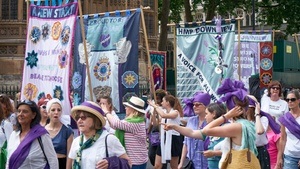
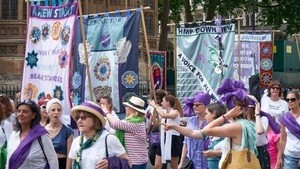
Because textiles have accompanied human history, this exhibition tells the story of ancient craftsmanship, the history of industrialization through to digitalization. At the same time, fabric works have their very own inherent critical potential: although modern art and abstraction have received numerous inspirations from textile art - including from non-European traditions - their significance is often misjudged and their works relegated to the realms of applied or hobby art. Contemporary positions counter this attitude with their criticism and narrative styles, which are dedicated to non-European traditions. In the course of feminist art movements, their association with female housework turned knitting and sewing into a political gesture of protest against patriarchy in society and art.
Unlike the painted canvas, the dyed thread is woven into the fabric. Textile artworks are therefore not just mere information carriers. In this intimate connection between content and form, this exhibition highlights them as "messengers". This exhibition thus encourages visitors to learn to "read" fabrics again. It presents artistic positions that use the techniques of knotting, weaving and sewing to tell stories, bring communities together and shed light on historical and current global contexts.
This content has been machine translated.Price information:
6 €, 3 € reduced, Free admission on Wednesdays
Location
You might enjoy this as well?








Events near you
Activities near you
Popular event locations
The best event recommendations for the Rausgegangen App!

Gemeinsam Events erleben
Events werden noch schöner wenn wir sie teilen! Deshalb kannst du dich jetzt mit Friends und anderen Usern vernetzen um Events gemeinsam zu besuchen. Loslegen